PAID ADS
How to Run Meta Ads With a Small Budget
You don't need a big ad spend to get results on Facebook and Instagram. Here's how small businesses can make $500/month on Meta ads work hard.
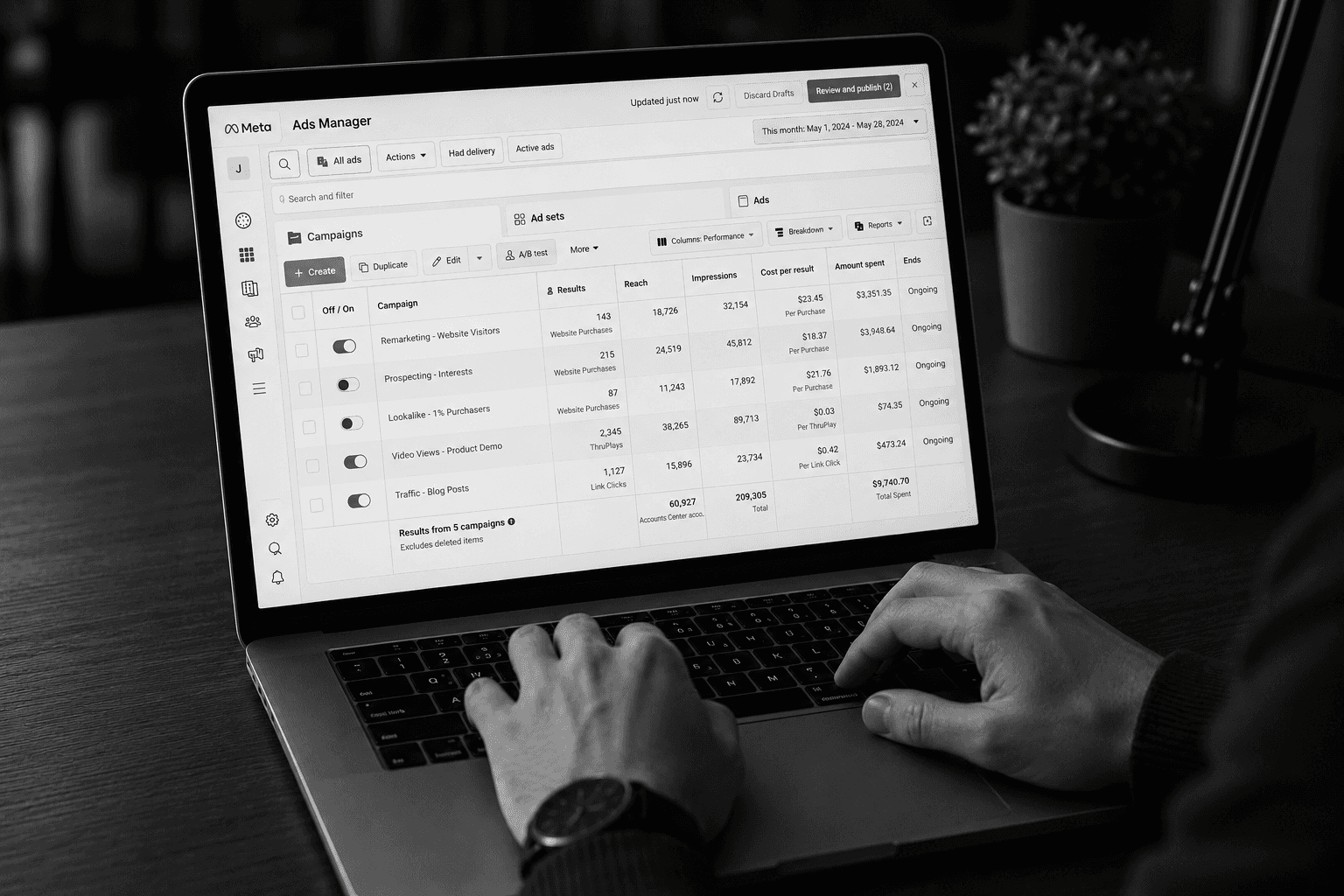
A lot of small business owners assume Meta ads are only for companies with deep pockets.
But here's the thing: budget size matters a lot less than how you use it. Five hundred dollars a month, managed well, can generate real leads, real traffic, and real sales. Managed poorly, even five times that won't move the needle.
Here's how to make a modest Meta ad budget actually work.
Start With One Campaign, Not Five
The most common mistake small businesses make with a limited budget is spreading it too thin. Running four or five campaigns at $100 each means none of them have enough data to optimize properly. Meta's algorithm needs time and spend to learn who your best customers are, and it can't do that when it's being fed a trickle.
Instead, start with a single campaign focused on your most important objective. If you're trying to generate leads, run one lead generation campaign. If you want website traffic, run one traffic campaign. Give it room to breathe.
A reasonable starting split for $500/month looks something like this:
$350 to $400 on your primary conversion or lead campaign
$100 to $150 on a retargeting campaign aimed at people who've already visited your site or engaged with your content
That retargeting audience is warmer and cheaper to convert, so even a small budget there punches above its weight.
Know the Difference Between Awareness and Action
Meta offers a wide range of campaign objectives, and choosing the wrong one is a fast way to burn through budget without results. If your goal is to get people to fill out a form or buy something, don't run an awareness campaign. Run one optimized for leads or conversions.
At $500/month, you can't afford to pay for impressions and hope they turn into something. Every dollar should be pointed at an action.
Your Creative Is Doing More Work Than Your Budget
On a limited budget, your ad creative is your biggest lever. A compelling image or video with a clear message will outperform a bland ad with twice the spend behind it.
A few things that work well for small businesses:
Real photos over stock images. A photo of your actual product, team, or space builds trust faster than anything generic.
One clear message per ad. Don't try to say everything. Pick one thing you want the viewer to do and write the ad around that.
Test two versions. Even with a small budget, running two variations of the same ad (different headline or image) gives you data to improve over time.
Narrow Your Audience
One of the best things about Meta ads is targeting, and one of the worst mistakes is ignoring it. If you're a local business in Cache Valley or southern Idaho, you don't need to pay to reach people in Denver or Phoenix.
Tighten your geographic targeting to where your customers actually are. Layer in one or two demographic or interest filters if they're relevant, but don't over-narrow to the point where your audience is too small for the algorithm to work with. Somewhere between 50,000 and 500,000 people is usually a healthy range for a local campaign.
Give It 30 to 60 Days Before Judging It
Meta ads have a learning phase. When you launch a new campaign, the algorithm is figuring out who to show it to. That process takes time and a certain number of conversions before it stabilizes.
If you check your results after three days and pull the plug because nothing happened, you've wasted your spend and never gave the campaign a real shot. Set a 30-day minimum before making major changes, and let the data tell you what to adjust.
What $500/Month Is and Isn't
To be clear: $500/month on Meta ads is not a growth engine on its own. It’s a starting point. It can keep your brand visible in your local market, generate a steady trickle of leads, and test what messaging resonates with your audience. If you find something that converts, you’ll have the evidence you need to justify increasing the budget.
What it won't do is replace a solid organic strategy or make up for a weak offer. Ads amplify what's already working. If your website is unclear, your offer isn't compelling, or your follow-up process is slow, more ad spend won't fix that.
The businesses that get the most out of a small Meta budget are the ones who treat it as a testing ground first and a scaling tool second.
If you're running Meta ads and not sure whether your budget is being spent the right way, we're happy to take a look. AdVantage works with small businesses across Utah, Idaho, and beyond to build paid social strategies that make sense for where you actually are right now.
(RELATED SERVICE)


